
For many people, the legal system only becomes visible when something has already gone wrong.
A family dispute reaches court.
A marriage becomes a legal issue.
Parents disagree over child custody.
Someone needs to file a case but does not know where to begin.
A person cannot afford a lawyer.
Or a citizen simply does not know what rights—and responsibilities—the law gives them.
This makes women’s rights in Kurram, legal awareness, and access to justice much more than courtroom issues. They affect families, children, property, marriage, personal safety, documentation, education, and everyday life.
And for women in particular, approaching the justice system can sometimes involve additional social and cultural barriers.
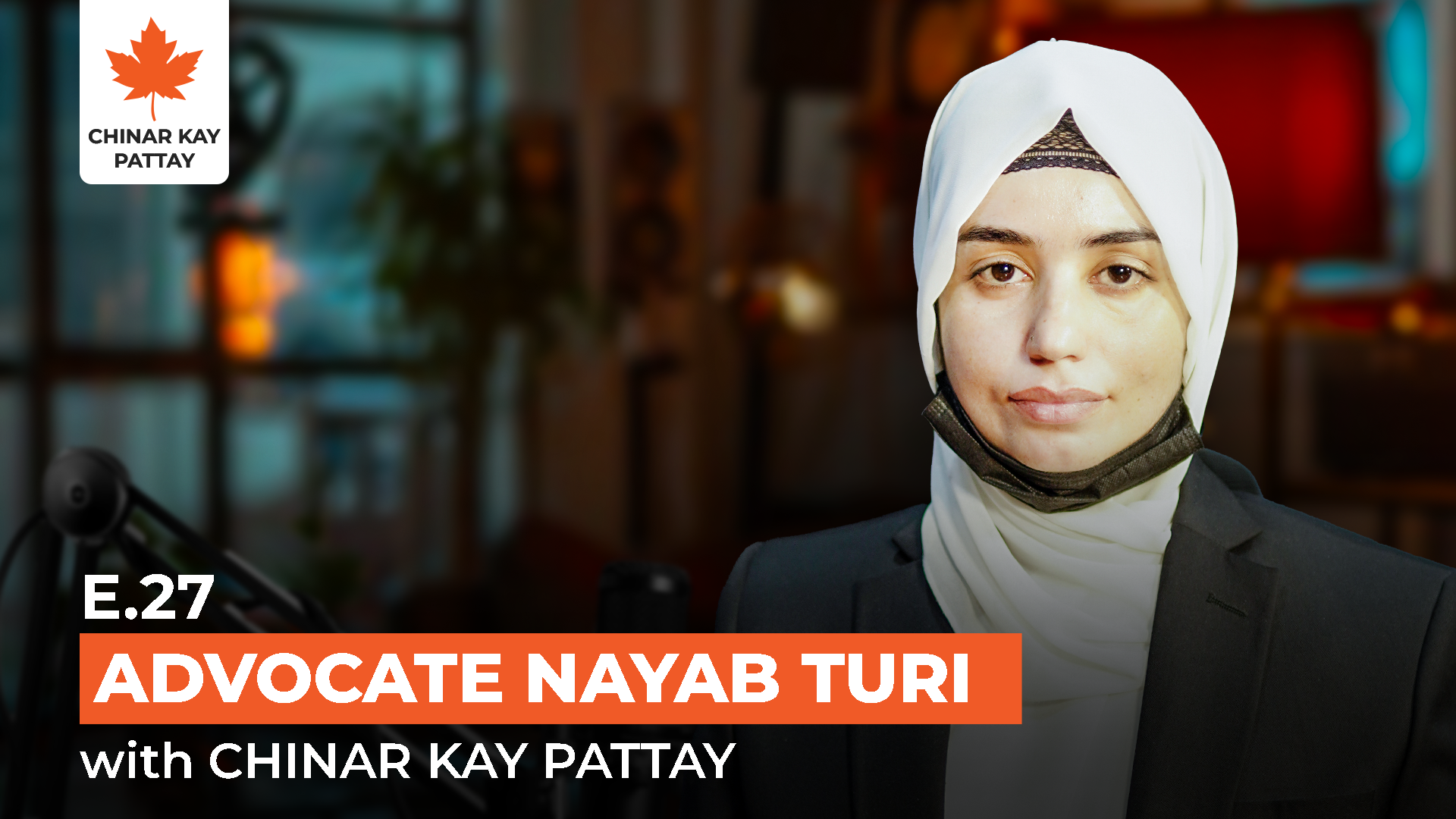
In Episode #027 of the Chinar Kay Pattay Podcast, host Shahid Hussain sits down with Advocate Nayab Turi, introduced in the episode as the first woman advocate from FATA, for an extensive conversation about law, women’s rights, justice, family disputes, courts, legal awareness, and social challenges in Parachinar and Kurram District.
The discussion also explores Nayab Turi’s own journey into the legal profession, the response she received as a female lawyer, difficulties she has faced in her work, the kinds of cases she handles, and the legal knowledge ordinary citizens should understand before they ever find themselves inside a courtroom.
But this episode is not only about one lawyer’s career.
It raises a much larger question:
How can ordinary people understand their rights, use the justice system responsibly, and make legal awareness part of a stronger and fairer society?
Watch the Full Podcast
Chinar Kay Pattay Podcast #027
Guest: Advocate Nayab Turi
Host: Shahid Hussain
Topic: Women’s Rights, Law, Justice and Legal Awareness in Kurram
Episode: #027
The complete conversation is available on the official Chinar Kay Pattay YouTube channel.
Table of Contents
Episode Timestamps
00:00:00 — Trailer
00:01:54 — Introduction & Why She Chose Law
00:08:07 — Women’s Reaction to Having a Female Lawyer
00:09:42 — Saaz, Forced Marriages & Women’s Issues
00:11:02 — Threats Faced as a Female Advocate
00:12:18 — How Citizens Can Approach Court
00:15:38 — Types of Cases Handled
00:19:15 — Child Custody After Divorce
00:30:53 — Basic Legal Knowledge People Should Have
00:32:15 — Women’s Cases & Challenges
00:34:44 — Shooting a Thief: Legal Perspective
00:36:45 — Date of Birth & Documentation Issues
00:37:44 — What If a Person Cannot Afford a Lawyer?
00:38:39 — Reforms Needed in Parachinar Courts
00:40:13 — Jirga vs Court
00:42:43 — Women’s Education & Disabled Children
00:46:01 — Drug Addiction in Youth
00:47:44 — Child Abuse
00:49:36 — Rights & Duties of Citizens
00:52:23 — Chinar Kay Pattay — Closing Segment
Advocate Nayab Turi’s Journey into Law
Entering the legal profession is demanding for anyone.
For a woman coming from a region where women have historically had limited representation in some public and professional spaces, the journey can carry an additional significance.
In this episode, Advocate Nayab Turi discusses why she chose law and what led her toward the legal profession.
The episode introduces her as the first woman advocate from FATA, making her professional journey an important part of the conversation.
Her story is not significant merely because she entered a traditionally male-dominated field.
The larger importance lies in what representation can make possible.
When women see someone from their own region working as an advocate, appearing in court, handling legal cases, and speaking publicly about rights and justice, a profession that may once have seemed distant becomes more imaginable.
Representation can also have a practical effect.
For some women, discussing sensitive legal or family matters with another woman may feel easier than approaching an unfamiliar male professional.
That does not make female lawyers responsible only for women’s cases.
But it does demonstrate why having greater diversity within the legal profession can improve access, confidence, and representation.
What a Female Lawyer Means for Women Seeking Justice
One of the most revealing parts of the conversation concerns how women reacted to having access to a female advocate.
Legal problems involving marriage, family relationships, custody, abuse, property, or personal circumstances can be deeply private.
In socially conservative environments, some women may find it difficult to discuss those matters openly.
The presence of a female lawyer can therefore create an additional avenue through which women may feel more comfortable asking questions or explaining sensitive circumstances.
But greater access requires more than simply having women working in law.
People also need to know:
- when a problem is legally actionable;
- where to seek help;
- what documentation may be required;
- what legal processes exist;
- and when professional legal advice is necessary.
A lawyer can only help someone who is able to reach the legal system in the first place.
That is why representation and legal awareness need to grow together.
Forced Marriage, “Saaz” and Women’s Legal Challenges
The conversation moves into particularly sensitive territory when discussing “Saaz,” forced marriages, and other problems affecting women.
These subjects should be understood carefully because they involve personal rights, family relationships, local customs, and legal protections.
The episode raises questions about situations in which women may face pressure or decisions being made about their lives without meaningful choice.
Rather than treating such issues purely as private family matters, legal awareness requires asking whether an individual’s rights are being respected.
This is particularly important in cases involving marriage.
Consent, documentation, age, family pressure, and access to legal support can all become relevant depending on the circumstances.
The episode gives CKP’s audience an important starting point:
people should not assume that every socially accepted practice is automatically legally valid, and they should not assume that every family dispute has no legal dimension.
Where a situation involves coercion, abuse, forced marriage, threats, or another serious concern, professional legal advice may be necessary.
The Risks and Pressures of Working as a Female Advocate
Advocate Nayab Turi also discusses threats she has faced while working as a female lawyer.
Legal professionals can become involved in deeply contested disputes.
Family cases, criminal matters, property disagreements, and other conflicts can produce strong emotions.
For women working in highly visible professional roles, those pressures may also interact with social expectations about women’s participation in public life.
Her discussion highlights an issue broader than one individual:
a justice system depends on lawyers being able to perform their professional responsibilities without intimidation.
If advocates, witnesses, litigants, or other participants in legal proceedings feel threatened, access to justice itself can be weakened.
The experiences described in the podcast therefore raise important questions about professional safety, social acceptance, and the support available to women who enter challenging public professions.
How Ordinary Citizens Can Approach the Courts
For someone who has never dealt with the legal system, a court can seem complicated and intimidating.
Where do you begin?
Do you need a lawyer immediately?
Which court handles your issue?
What documents should you bring?
How much will the process cost?
These uncertainties can discourage people from seeking legal remedies even when they may have a legitimate case.
The podcast addresses how ordinary citizens can approach the courts and provides an opportunity to discuss a broader principle:
basic legal literacy is part of citizenship.
People do not need to become lawyers.
But they should have some understanding of:
- how legal disputes are formally raised;
- why documentation matters;
- when professional legal advice is needed;
- what role lawyers play;
- and why court procedures cannot simply be replaced by assumptions or social-media advice.
The details of any case depend on its facts and the applicable law.
For that reason, a podcast discussion should be treated as legal awareness—not personalised legal advice.
Family Cases, Divorce and Child Custody
Family disputes are among the most emotionally difficult legal matters.
Divorce can affect not only two spouses but also children, finances, residence, family relationships, and future responsibilities.
The episode includes a substantial discussion about child custody after divorce.
Custody cases can be particularly sensitive because public discussion often reduces them to a simple question:
Who gets the child?
In reality, family-law matters can involve multiple legal considerations, and the answer may depend on the circumstances of the case and the applicable legal framework.
Children should not be treated merely as property to be divided between adults.
Their welfare, care, safety, living arrangements, and relationship with parents can all become relevant considerations.
For people facing an actual custody dispute, general podcast information is not enough.
They should obtain legal advice based on their particular circumstances.
What the episode can do—and does importantly—is help people understand that custody is a legal issue that deserves proper process rather than assumptions based purely on social expectations.
Why Basic Legal Knowledge Matters
One of the most useful themes in the episode is the importance of basic legal knowledge.
Most people will never study law.
But everyone lives within a legal system.
Births are documented.
Marriages create legal relationships.
Property is transferred.
Contracts are signed.
Children have rights.
Citizens interact with police and government institutions.
Families may face inheritance questions.
Businesses enter agreements.
And disputes sometimes reach court.
A lack of basic legal knowledge can make people vulnerable to misinformation, exploitation, unnecessary disputes, or poor decisions.
Legal awareness therefore does not mean memorising sections of legislation.
It means understanding enough to recognise when a legal issue exists and knowing when to ask for professional help.
That knowledge can be especially important in communities where people may otherwise depend heavily on informal advice from relatives, acquaintances, or social media.
Women’s Rights in Kurram and Access to Justice
The discussion around women’s rights in Kurram goes beyond one type of case.
Women may encounter legal questions related to marriage, divorce, family disputes, custody, education, property, violence, documentation, or other areas of life.
But having rights on paper and being able to exercise those rights are not always the same thing.
Access can be affected by:
- awareness;
- social pressure;
- financial limitations;
- mobility;
- family support;
- fear of stigma;
- availability of lawyers;
- and confidence in institutions.
This is why legal awareness is particularly important.
A person cannot make an informed decision about a right they do not know exists.
At the same time, improving women’s access to justice should not be reduced to encouraging litigation in every disagreement.
Courts are one part of a wider legal and social system.
The goal should be that women understand their options, are able to seek appropriate advice, and are not prevented from accessing lawful remedies simply because of gender or social pressure.
Self-Defence, Crime and Why Legal Context Matters
The episode includes a discussion framed around the question of shooting a thief and the legal perspective surrounding such an incident.
Questions involving self-defence, violence, property protection, firearms, and criminal liability are highly fact-specific.
A simple statement such as “someone was a thief” does not automatically resolve what actions were legally justified.
Legal consequences may depend on circumstances such as:
- whether there was an immediate threat;
- what level of force was used;
- whether someone’s life or safety was at risk;
- what actually occurred;
- and what the applicable law provides.
This is exactly why people should be cautious about turning general legal discussions into personal legal instructions.
The podcast can help raise awareness that self-defence and retaliation are not necessarily the same thing legally.
Anyone involved in a real incident should seek qualified legal counsel rather than relying on generalised interpretations from a podcast or social-media discussion.
Birth Records and Documentation Problems
Something as basic as an incorrect date of birth can create legal and administrative problems for years.
The episode discusses issues surrounding dates of birth and documentation.
Official records can affect:
- education;
- identity documents;
- employment;
- passports;
- inheritance;
- marriage documentation;
- government services;
- and court proceedings.
Incorrect information entered early in life may later become difficult to correct.
This highlights a practical lesson for families:
documentation should not be treated as an insignificant formality.
Birth records and other official documents should be created carefully, preserved properly, and checked for accuracy.
When a discrepancy already exists, the correct legal or administrative procedure should be followed rather than trying to solve the problem informally.
What Happens When Someone Cannot Afford a Lawyer?
Access to justice becomes difficult if legal assistance is available only to people who can afford it.
The podcast asks an important practical question:
What can someone do if they cannot afford a lawyer?
The exact legal-aid options available to an individual can depend on jurisdiction, case type, applicable programmes, and current institutional arrangements.
For that reason, specific legal-aid pathways should be verified before publication if they are to be listed in detail.
But the broader principle is important.
A person’s financial situation should not mean they are completely excluded from understanding or pursuing their legal rights.
Legal aid, pro bono assistance, public-sector mechanisms, bar-related support, or other forms of assistance may be relevant depending on the case and location.
Making those pathways understandable and visible is itself an important part of improving access to justice.
What Reforms Could Improve Access to Justice?
The conversation also examines possible reforms needed within the court system in Parachinar.
A functioning justice system is not measured only by the existence of courts.
People also care about:
- accessibility;
- efficiency;
- affordability;
- fairness;
- transparency;
- case delays;
- professional conduct;
- and confidence in outcomes.
Any serious discussion about court reform therefore needs to look at the experience of ordinary citizens as well as legal professionals.
What obstacles make the process difficult?
Where do delays occur?
Do people understand procedures?
Can women access legal help comfortably?
Can financially vulnerable citizens obtain support?
Do people trust formal institutions enough to use them?
These questions can help shift the conversation from simply criticising institutions toward identifying where systems can become more accessible and effective.
Jirga vs Court: Two Different Paths to Dispute Resolution
Kurram has a long history of tribal and community dispute-resolution mechanisms, including the Jirga system.
The episode compares Jirga and court processes.
This comparison deserves nuance.
A Jirga may offer community-based dialogue and mediation within particular social contexts.
A court, by contrast, operates within the formal legal system and applies established legal procedures and enforceable law.
The two should not automatically be treated as interchangeable.
Different disputes may involve different legal requirements.
There can also be situations where individual rights, criminal liability, due process, or formal legal remedies require the involvement of courts and state institutions.
The useful public question is therefore not simply:
“Which is better: Jirga or court?”
A more meaningful question is:
What type of dispute is being addressed, what rights are involved, and which mechanism is legally appropriate and capable of producing a fair outcome?
Women’s Education and the Rights of Children with Disabilities
The discussion expands beyond courtrooms into wider social questions, including women’s education and children with disabilities.
Education can influence much more than employment.
For women, education can affect:
- confidence;
- awareness of rights;
- economic participation;
- decision-making;
- family wellbeing;
- and the ability to navigate institutions.
The treatment and inclusion of children with disabilities raises another important question:
How does a society respond to people who require additional support?
Children with disabilities should not be defined only by limitations.
Their access to education, dignity, care, participation, and opportunity matters.
These issues may sit outside the narrow definition of courtroom law, but they are closely connected to justice in a broader social sense.
A fair society is not only one that resolves disputes after harm occurs.
It is also one that gives people a meaningful opportunity to participate in education and community life.
Drug Addiction, Child Abuse and Wider Social Problems
Toward the later part of the conversation, the episode touches on drug addiction among young people and child abuse.
Both are serious issues and should be discussed responsibly.
Drug addiction can have legal, health, family, and social consequences.
Child abuse can involve severe harm and may require immediate protection and involvement from appropriate authorities or professionals.
Neither issue should be reduced to gossip, stigma, or informal punishment.
Public awareness is important because people need to recognise that some problems require professional and institutional intervention.
At the same time, allegations involving identifiable individuals should never be treated as established fact without proper evidence and legal process.
CKP’s role in discussing these issues is therefore primarily educational:
to encourage awareness, responsible reporting, appropriate help-seeking, and respect for legal processes.
Rights and Duties of Citizens
A discussion about rights is incomplete without discussing responsibilities.
Citizens have legitimate expectations of the state and justice system.
They should be able to expect lawful treatment, access to institutions, due process, and protection of their rights.
But citizenship also involves duties.
Communities function better when people:
- respect the rights of others;
- follow lawful processes;
- avoid spreading false accusations;
- preserve accurate documentation;
- cooperate with legitimate institutions;
- and understand that personal disagreements do not justify unlawful actions.
Legal awareness should therefore create both empowered citizens and responsible citizens.
Knowing your rights should not mean believing that only your rights matter.
Justice depends on recognising that other people have rights as well.
What This Conversation Means for Kurram
Episode #027 covers many different subjects, but they are connected by one central issue:
access to justice requires knowledge.
A woman who does not know her legal options may remain silent.
A parent who does not understand documentation may create problems for a child unintentionally.
A person facing a family dispute may follow incorrect advice.
Someone unable to afford a lawyer may assume no legal help is possible.
A citizen may misunderstand what self-defence legally permits.
And communities may confuse informal dispute resolution with formal legal authority.
Legal literacy can reduce some of these gaps.
That does not mean every person needs to become a legal expert.
It means people should understand enough to know:
when something is a legal issue, where to seek help, and why professional advice matters.
Advocate Nayab Turi’s journey also adds another dimension.
When women enter professions such as law, they do more than build individual careers.
They expand who can participate in institutions and who other young women can imagine becoming.
Key Takeaways from the Episode
- Advocate Nayab Turi is introduced in the episode as the first woman advocate from FATA.
- Female representation in the legal profession can make legal services more approachable for some women facing sensitive issues.
- Forced marriage and other serious women’s issues should be understood through both social and legal perspectives.
- Lawyers and other participants in the justice system need to be able to work without intimidation.
- Ordinary citizens benefit from understanding basic legal processes even if they never study law formally.
- Divorce and child-custody matters require proper legal assessment rather than assumptions based on social custom.
- Legal rights become more meaningful when people actually know they exist and understand how to seek help.
- Questions involving self-defence and criminal liability depend heavily on the specific facts and applicable law.
- Accurate birth records and documentation can prevent serious administrative and legal problems later.
- Financial limitations can create barriers to justice, making access to appropriate legal assistance an important public issue.
- Jirga and court processes should not automatically be treated as interchangeable.
- Women’s education and the inclusion of children with disabilities are also connected to broader questions of social justice.
- Issues such as drug addiction and child abuse require responsible awareness, professional intervention, and proper legal processes.
- Rights and responsibilities should be understood together.
Building a More Legally Aware Community
Law becomes most useful when people understand it before they are already in crisis.
Legal awareness can help someone recognise a problem earlier.
It can help a woman understand that she has options.
It can help parents protect their children’s documentation.
It can help families understand that some disputes require professional advice.
And it can help citizens distinguish between personal opinion, social custom, and what the law actually provides.
Advocate Nayab Turi’s conversation on the Chinar Kay Pattay Podcast brings many of these questions into one discussion.
Her own journey also illustrates what can happen when individuals enter professions where representation from their community has historically been limited.
But the larger message of this episode goes beyond one advocate.
A stronger justice system also requires a more legally aware public.
People need to know their rights.
They need to understand their responsibilities.
They need access to trustworthy legal information.
And when serious legal issues arise, they need to know when to seek qualified professional help.
For Parachinar and the wider Kurram District, legal awareness is therefore not only about courts.
It is about helping people make better decisions, protect their rights, respect the rights of others, and interact with institutions with greater understanding and confidence.
Watch the Full Episode
Watch First Woman Advocate of FATA ft. Advocate Nayab Turi | Women’s Rights, Law & Justice | Chinar Kay Pattay Podcast #027 on the official Chinar Kay Pattay YouTube channel.
Subscribe to Chinar Kay Pattay for more conversations about Kurram, its people, law, education, social issues, culture, development, opportunities, and future.
Official Website
Facebook
Instagram
TikTok
If this conversation can help someone better understand their legal rights, responsibilities, or options, consider sharing it with them.
Important: This article summarizes themes discussed in the CKP podcast and is intended for general legal awareness. It is not a substitute for legal advice about an individual case.