
Education is often measured through schools, colleges, degrees, literacy rates, and examination results.
But real education is much broader.
It shapes how people think, how they behave, how they solve problems, how they treat others, and how they contribute to the society around them.
This is why the conversation around education in Kurram cannot be limited to classrooms alone.
It also connects with culture, ethics, social responsibility, peace, history, and the values passed from one generation to another.
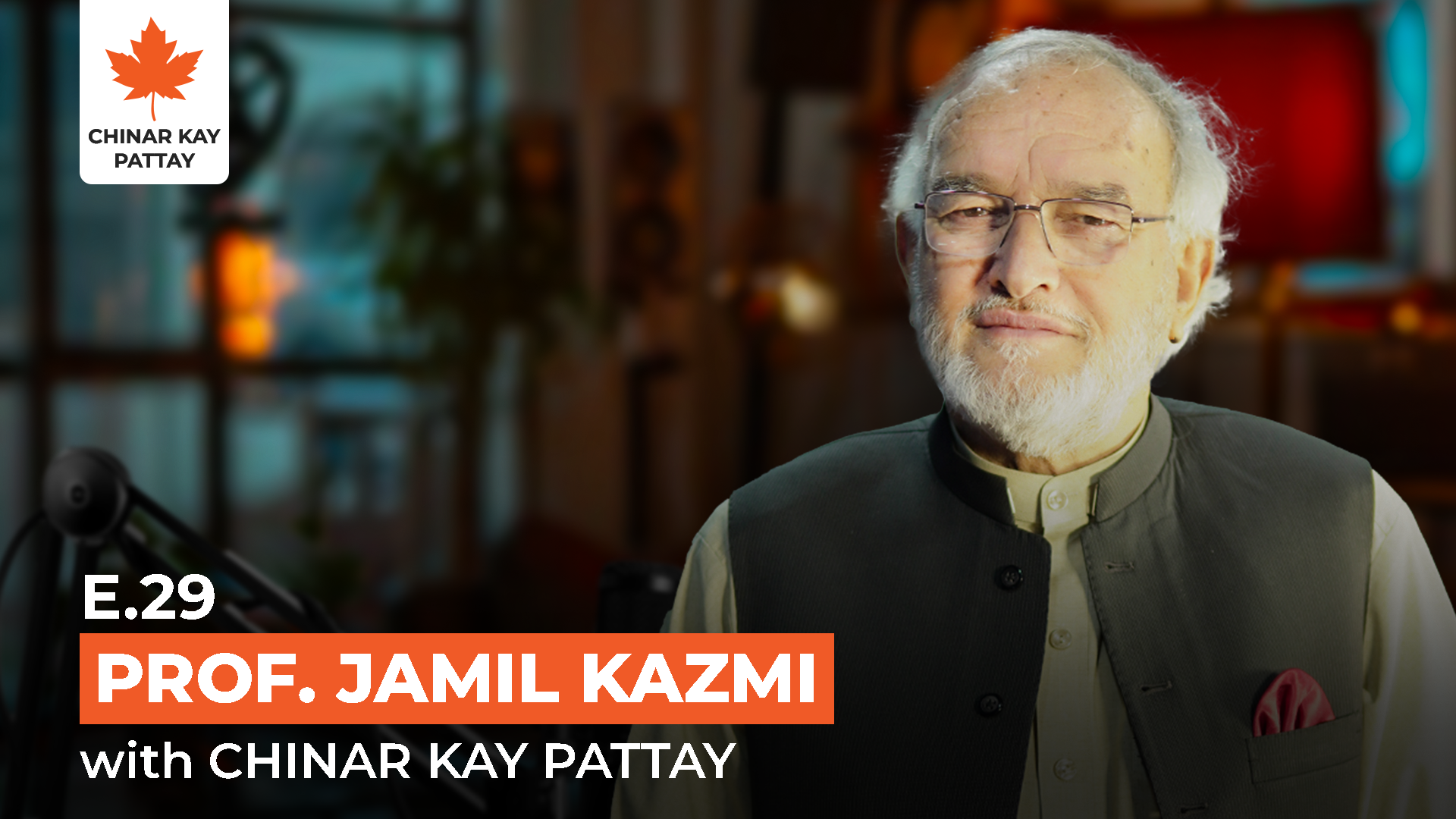
In Episode #029 of the Chinar Kay Pattay Podcast, host Shahid Hussain sits down with Prof. Jamil Kazmi, a retired professor and experienced educationist, for a thoughtful discussion on education, cheating, social imbalance, peace, culture, poetry, and the history of District Kurram.
The episode asks several important questions:
What does education actually mean?
Why does cheating weaken the education system?
Why can a society have more educated people but still struggle with social imbalance?
What responsibility do educated individuals carry toward peace and community development?
And what makes the culture and identity of Kurram distinctive?
The result is a conversation that connects the classroom with the wider society.
Watch the Full Podcast
Chinar Kay Pattay Podcast #029
Guest: Prof. Jamil Kazmi
Host: Shahid Hussain
Guest Role: Retired Professor / Educationist
Topic: Education, Culture, Society and the Identity of Kurram
The complete conversation is available on the official Chinar Kay Pattay YouTube channel.
Table of Contents
Episode Timestamps
00:00 — Trailer
01:52 — Introduction
03:26 — What Is Education? Explained Simply
05:33 — Cheating in the Education System
07:55 — His Students & Colleagues in Various Fields
09:45 — His Favorite Poets & Influences
14:34 — Role of Educated Individuals in Peace & Society Building
18:33 — Why Society Is Still Imbalanced Despite Higher Literacy
23:53 — History of Kurram Agency & Parachinar
27:34 — Why Kurram Is Culturally Rich Compared to Other FATA Regions
32:06 — Political Figures Who Visited Parachinar
33:20 — How to Build a Cheating-Free Education System
38:53 — Chinar Kay Pattay — Closing Segment
What Does Real Education Mean?
One of the strongest parts of the conversation begins with a deceptively simple question:
What is education?
Education is often reduced to certificates and examination results.
A student passes matriculation.
Then intermediate.
Then university.
Eventually, they earn a degree.
But completing formal education does not automatically mean someone has developed judgement, character, responsibility, or the ability to contribute positively to society.
The episode explores education as something deeper than academic qualification.
Real education should help a person learn how to:
- think critically;
- understand society;
- distinguish right from wrong;
- communicate respectfully;
- make responsible decisions;
- solve problems;
- and contribute beyond personal success.
This distinction matters.
A society may produce many degree-holders while still struggling with dishonesty, intolerance, poor civic behaviour, or weak institutions.
Education becomes truly valuable when knowledge begins to influence behaviour.
That is one of the central ideas running through Prof. Jamil Kazmi’s discussion.
How Cheating Weakens the Education System
Cheating is often treated as an individual student problem.
But when it becomes normalised, it becomes a system problem.
The episode examines cheating in education and why it damages much more than examination integrity.
When students pass through dishonest means, the immediate result may be a better mark.
The long-term result can be much more serious.
A weak system can produce certificates without competence.
Students may move into higher education without mastering earlier concepts.
Professional qualifications can lose credibility.
Teachers who work honestly may become discouraged.
And students who refuse to cheat may feel disadvantaged.
Cheating also sends a deeper social message:
results matter more than learning.
That is dangerous because education should reward understanding, effort, discipline, and capability.
If marks become more important than knowledge, the purpose of education begins to change.
The problem therefore cannot be solved only by blaming students.
Parents, teachers, institutions, examination boards, invigilators, and wider social expectations can all influence the environment in which cheating either becomes difficult or becomes normal.
A cheating-free education system requires a culture in which honesty is protected and meaningful learning actually matters.
The Long-Term Influence of Teachers
Prof. Jamil Kazmi also reflects on students and colleagues who went on to work in different professions.
For an educator, this is one of the most meaningful measures of a career.
A teacher may spend only a few years directly teaching a student, but the influence can continue for decades.
Former students can become:
- teachers;
- doctors;
- administrators;
- businesspeople;
- researchers;
- public servants;
- writers;
- professionals;
- and community leaders.
This is why teaching is not simply the transfer of information.
Teachers help shape people who later participate in almost every other part of society.
Their influence can extend far beyond the classroom.
But that also makes teaching a serious responsibility.
If students learn only how to pass examinations, education remains incomplete.
If they learn discipline, intellectual curiosity, integrity, respect, and responsibility alongside academic knowledge, the influence of a good teacher becomes much broader.
Poetry, Literature and Intellectual Influence
The conversation also moves into poetry and the writers who influenced Prof. Jamil Kazmi.
This part of the episode helps reveal another dimension of education.
People are not shaped only by textbooks.
They are also shaped by:
- literature;
- poetry;
- language;
- stories;
- history;
- teachers;
- family traditions;
- and cultural memory.
Poetry can preserve emotions and experiences that formal historical records sometimes fail to capture.
It can express:
- identity;
- loss;
- belonging;
- love;
- conflict;
- social criticism;
- memory;
- and hope.
For a region such as Kurram, literary traditions can therefore contribute to understanding how people see themselves and their history.
This is also why education and culture should not be separated completely.
An education system that ignores local language, literature, history, and cultural knowledge risks producing students who understand the outside world but know very little about their own society.
The stronger model is not isolation.
It is balance:
learning from the wider world while understanding where you come from.
The Role of Educated People in Peace and Society
One of the most important questions in the episode concerns the responsibility of educated people toward peace.
Education creates capability.
But capability also creates responsibility.
Someone who has had greater access to knowledge may be better positioned to:
- question misinformation;
- understand complexity;
- communicate responsibly;
- mediate disagreements;
- challenge harmful narratives;
- and contribute constructively to public discussion.
This becomes especially important in regions where social tensions can have serious consequences.
An educated person who spreads rumours, inflames divisions, or uses knowledge only for personal advantage is not necessarily contributing to a healthier society.
Degrees alone do not create peace.
What matters is how knowledge is used.
Educated individuals can contribute to society by helping people understand issues more accurately and by refusing to turn every disagreement into hostility.
The larger principle is:
education should increase social responsibility, not only individual opportunity.
Why Education Alone Does Not Automatically Create Social Balance
The episode raises a difficult question:
If literacy and formal education have increased, why does society still experience imbalance and social problems?
The answer is not simple.
Education can improve opportunities, awareness, and professional capability.
But education alone cannot automatically create:
- justice;
- tolerance;
- economic opportunity;
- strong institutions;
- ethical behaviour;
- social trust;
- or peace.
A society is shaped by many systems at the same time.
Family environments matter.
Economic conditions matter.
Institutions matter.
Politics matters.
Culture matters.
Social norms matter.
Leadership matters.
And the quality of education itself matters.
This is why simply increasing the number of degree-holders does not guarantee social progress.
The more meaningful question is:
What kind of education are people receiving, and what kind of citizens is that system producing?
If education develops knowledge without character, qualifications without competence, or ambition without responsibility, its social impact will remain limited.
Understanding the History of Kurram and Parachinar
The conversation also turns toward the history of Kurram Agency and Parachinar.
Prof. Jamil Kazmi shares his perspective on the region’s historical background and identity.
Historical knowledge matters because communities are shaped by more than current events.
Understanding how a region developed can help people better understand:
- settlement patterns;
- institutions;
- tribal relationships;
- cultural influences;
- political change;
- and local identity.
For younger generations in particular, local history can easily become disconnected from everyday education.
Students may learn national and international history while knowing relatively little about the history of their own district.
That creates an important opportunity for Kurram.
Local history should be documented carefully.
Oral histories, written sources, photographs, archives, poetry, family records, and scholarly research can all help preserve knowledge that may otherwise disappear.
However, historical claims require verification.
The details discussed in the podcast should therefore be understood as Prof. Jamil Kazmi’s historical discussion unless individual claims are independently checked against reliable sources.
What Makes Kurram Culturally Distinct?
The podcast also explores why Prof. Jamil Kazmi considers Kurram culturally rich compared with other former FATA regions.
Kurram has its own combination of:
- languages;
- tribal traditions;
- poetry;
- religious traditions;
- food;
- dress;
- social customs;
- landscapes;
- architecture;
- and historical experiences.
These elements contribute to a distinct regional identity.
Cultural richness does not necessarily mean one culture is superior to another.
Every region develops through its own history and social environment.
The more useful way to understand Kurram’s cultural distinction is to ask:
What traditions have survived?
What languages and literary traditions remain active?
What forms of music, poetry, storytelling, architecture, clothing, and social practice are distinctive?
Which traditions are disappearing?
And what should younger generations preserve?
Culture is not something that remains automatically.
It survives when people document it, practice it, teach it, and give it space in modern life.
This is where education can again play an important role.
Political and Historical Connections to Parachinar
The episode also touches on political figures who visited Parachinar.
Visits by national or political figures can form part of a region’s historical memory.
They can reflect:
- political importance;
- administrative changes;
- public events;
- regional relationships;
- or significant moments in local history.
However, dates, individuals, circumstances, and the significance of particular visits should be verified carefully before being presented as established historical facts in a written article.
For that reason, this section remains intentionally broad.
The podcast itself provides the detailed conversation, while any future CKP historical article on political visits to Parachinar should ideally be built from independently checked archival material.
This distinction matters because preserving history requires accuracy as much as storytelling.
How Can We Build a Cheating-Free Education System?
The conversation returns to education with one of the most practical questions in the episode:
How can cheating be reduced?
There is no single solution.
Stricter examination supervision can help.
But if the underlying system still rewards marks above understanding, cheating may simply take new forms.
A stronger response could involve several layers:
- better classroom teaching;
- concept-based learning;
- fair assessment;
- teacher accountability;
- examination integrity;
- parent awareness;
- student counselling;
- meaningful consequences for malpractice;
- and a culture that values actual competence.
Students also need a reason to value learning itself.
If they believe that only grades matter, the pressure to obtain those grades by any means can become stronger.
Educational reform therefore has to address both:
the opportunity to cheat
and
the mindset that makes cheating seem acceptable.
A cheating-free system is not created only in the examination hall.
It begins much earlier—in classrooms, homes, schools, and the expectations society creates around education.
What This Conversation Means for Students and Teachers
Episode #029 has an important message for both sides of the classroom.
For students:
Education should not become a race for certificates.
Marks matter, but knowledge matters more.
Skills matter.
Character matters.
The ability to think independently matters.
And the way education is used after graduation matters.
For teachers:
Teaching is not only about completing a syllabus.
A teacher can shape how students think about honesty, responsibility, curiosity, and society.
That influence can last long after the classroom itself is forgotten.
For parents:
Educational success should not be measured only by marks.
A child who understands concepts, develops confidence, behaves responsibly, and builds useful skills may ultimately be better prepared for life than a child who receives higher marks without genuine understanding.
The quality of education therefore depends on the expectations created by the entire community.
Education, Culture and Social Responsibility
At first glance, education and culture may seem like separate subjects.
But throughout this conversation, they repeatedly connect.
Education influences how a generation understands its culture.
Culture influences how people interpret education.
History shapes identity.
Poetry preserves memory.
Teachers influence society.
And educated citizens influence peace.
This creates a wider definition of education.
A truly educated society should be able to:
- preserve what is valuable from its past;
- question harmful practices;
- learn from outside knowledge;
- participate responsibly in public life;
- and prepare younger generations for the future.
That balance is difficult.
Preserving culture should not mean rejecting change.
Modernisation should not mean forgetting identity.
Education can help communities navigate between the two.
Key Takeaways from the Episode
- Education is broader than obtaining certificates or passing examinations.
- Real education should influence thinking, behaviour, responsibility, and contribution to society.
- Cheating damages both individual learning and the credibility of the wider education system.
- Teachers can influence students long after formal education ends.
- Poetry and literature can play an important role in preserving cultural identity and social memory.
- Educated individuals have a responsibility to contribute constructively to peace and public discourse.
- Higher literacy or more degrees do not automatically create a balanced society.
- The quality and purpose of education matter as much as access to education.
- Local history is worth documenting carefully and should be preserved through reliable sources.
- Kurram’s cultural identity includes its languages, traditions, literature, history, and social practices.
- Cultural richness should be understood as identity and heritage, not as a claim of superiority over other regions.
- Historical claims about Kurram and Parachinar should be independently verified before being treated as settled fact.
- Reducing cheating requires both stronger examination integrity and a deeper shift toward meaningful learning.
- Students, teachers, parents, and institutions all influence the quality of education.
- Education becomes more valuable when it produces responsible citizens as well as qualified professionals.
Building an Education System That Shapes Better Citizens
The strongest idea from Prof. Jamil Kazmi’s conversation may be that education should ultimately be visible in the kind of society it helps produce.
If education increases qualifications but dishonesty remains normal, something is missing.
If literacy increases but misinformation still spreads without question, something is missing.
If graduates succeed personally but feel no responsibility toward their communities, something is missing.
And if younger generations become disconnected from their own history, culture, and language, education has also lost part of its purpose.
For Kurram, this creates an opportunity to think about education more broadly.
The region needs students who understand concepts.
Teachers who take pride in teaching.
Institutions that protect academic integrity.
Young people who can compete professionally beyond Kurram.
And citizens who understand the history, culture, and society they come from.
These goals do not conflict with each other.
In fact, they strengthen one another.
A student can understand Kurram’s culture and still learn from the entire world.
A community can preserve its identity while embracing modern education, technology, and professional skills.
And an educated person can pursue personal success while still contributing to peace and social progress.
That is perhaps the larger lesson of this episode:
education should not only help people build careers. It should help build better individuals and, through them, a better society.
For students, teachers, parents, and anyone interested in the future of education and culture in Kurram, the complete conversation with Prof. Jamil Kazmi is worth watching.
Watch the Full Episode
Watch Education, Culture & Society in Kurram | ft. Prof. Jamil Kazmi | Chinar Kay Pattay Podcast #029 on the official Chinar Kay Pattay YouTube channel.
Subscribe to Chinar Kay Pattay for more conversations about Kurram, education, culture, history, social issues, opportunities, and the region’s future.
Official Website
Facebook
Instagram
TikTok
If you are a student, teacher, parent, or someone interested in Kurram’s history and culture, consider sharing this conversation with others who may benefit from it.