
Music can preserve things that written history sometimes cannot.
A melody can carry the memory of a wedding.
An instrument can remind people of a village, a generation, or a cultural tradition.
A folk tune can travel across borders and still remain familiar.
And when an old musician plays a melody learned decades ago, the performance becomes more than entertainment — it becomes part of cultural memory.
This is what makes Pashto folk music in Kurram more than a musical subject.
It is connected with language, identity, weddings, spirituality, local traditions, memories, and the people who have spent their lives preserving traditional sounds.
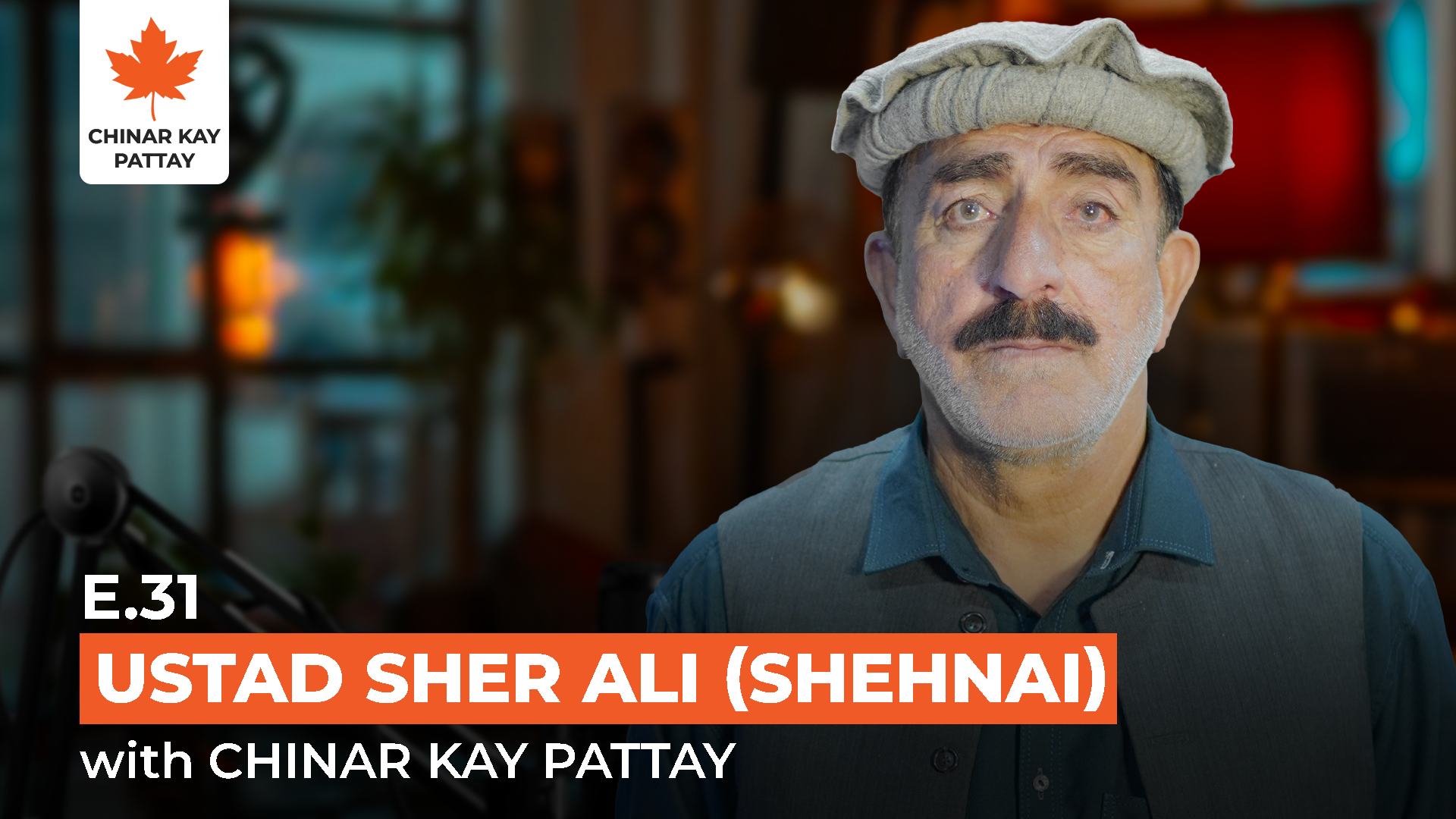
In Episode #031 of the Chinar Kay Pattay Podcast, the conversation turns toward this cultural heritage through the life and music of Ustad Sher Ali, a veteran Shehnai — or Surnai — musician.
The episode explores how he learned the instrument, his professional journey with the FC Band, traditional wedding music, Pashto folk melodies, Sufi music, the changing character of modern music, musical traditions shared across Kurram and Afghanistan, and instruments that are becoming less common.
Throughout the conversation, Ustad Sher Ali also performs several traditional compositions live, giving the episode something that cannot be captured through discussion alone:
the sound of the tradition itself.
Watch the Full Podcast
Chinar Kay Pattay Podcast #031
Guest: Ustad Sher Ali
Topic: Shehnai (Surnai), Pashto Folk Music, Sufi Music and Cultural Heritage
Episode: #031
The complete conversation and musical performances are available on the official Chinar Kay Pattay YouTube channel.
Table of Contents
Episode Timestamps
00:00 — Trailer
01:47 — Introduction to Ustad Sher Ali
04:26 — How & Why Ustad Sher Ali Learned the Shehnai (Surnai)
10:05 — Pashto Folk Performance — “Ro Ro Keda Kadamona Laila”
12:13 — His Professional Journey with the FC Band
14:24 — Old vs. Modern Music: What Has Changed & Why
17:46 — Sufi Music & Spiritual Expression
18:41 — Regions He Performed in with the FC Band
24:02 — Shehnai Performance — “Kamees Teri Kali” & “Larsha Pekhawar Ta”
27:31 — Imitation in Today’s Music: Why Originality Matters
34:29 — Rare Musical Instruments Played in Kurram
36:42 — Meetings with Legendary Pashto Singers
38:15 — Encounters with Military & Political Figures
39:57 — Wedding Stories & Traditional Wedding Music
43:53 — Similarities Between Afghan & Kurram Music
45:34 — Shehnai Performance — “Jawary Karma Ta Nasses Rawary Yama”
47:40 — A Sufi Shehnai Composition
49:13 — Chinar Kay Pattay — Closing Segment
Ustad Sher Ali and a Lifetime with the Shehnai
Traditional musicians often learn differently from formally trained musicians.
Their knowledge may come through observation, repetition, listening, memory, community gatherings, older musicians, and years of practical performance.
Ustad Sher Ali’s story reflects this kind of musical journey.
In the episode, he explains how and why he learned the Shehnai, also referred to locally as the Surnai, and how the instrument became part of his professional and cultural identity.
Learning an instrument like the Shehnai requires more than memorising melodies.
It involves breath control, listening, timing, tone, familiarity with traditional compositions, and the ability to perform in social settings where the musician responds to the atmosphere around him.
For musicians of Ustad Sher Ali’s generation, the instrument was also closely connected with community life.
The Shehnai could be heard at weddings, celebrations, gatherings, and traditional events.
That makes his musical journey part of a wider social history.
What Makes the Shehnai — or Surnai — Special?
The Shehnai is immediately recognisable because of its distinctive sound.
In different regions and musical traditions, related instruments may be known by different names, including Surnai or similar local variations.
Within the context of this episode, both Shehnai and Surnai are used to describe the traditional wind instrument associated with Ustad Sher Ali’s performances.
Its cultural importance comes partly from where it has historically been heard.
It is not simply an instrument designed for a concert stage.
It has been connected with:
- weddings;
- community celebrations;
- folk performances;
- traditional gatherings;
- ceremonial occasions;
- and musical storytelling.
The sound itself can become associated with particular memories.
For older listeners, hearing a traditional Shehnai composition may recall weddings, village gatherings, or musicians who are no longer performing.
For younger generations, it can be an introduction to a musical tradition they may rarely encounter today.
Learning Traditional Music Through Practice and Memory
Modern musicians can learn through conservatories, online lessons, tutorials, digital recordings, and formal notation.
Traditional musicians often came through a different path.
Knowledge moved from musician to musician.
A student listened.
Repeated.
Practised.
Observed performances.
Learned rhythms and melodies through memory.
And gradually developed an individual style.
Ustad Sher Ali’s discussion about learning the Shehnai offers a window into this older system of musical education.
That system has strengths.
It creates close relationships between music and lived culture.
But it also creates vulnerability.
If a musician carries dozens of traditional melodies only in memory and never records or documents them, those compositions can disappear when that musician is no longer able to perform.
This is one reason cultural documentation matters.
Preserving traditional music does not mean freezing it.
It means ensuring that future generations still have access to the sounds, stories, techniques, and people from which newer music developed.
Pashto Folk Music as Living Cultural Heritage
Folk music survives because communities continue to recognise themselves in it.
It may contain familiar words, rhythms, melodies, instruments, or emotional expressions that connect listeners with place and identity.
The episode includes several live performances of traditional Pashto compositions.
These performances demonstrate that Pashto folk music in Kurram is not only something to discuss historically.
It remains a living form of cultural expression.
Folk music can preserve:
- language;
- local expressions;
- social memory;
- stories;
- poetry;
- traditional melodies;
- and shared emotions.
It can also travel.
A melody may become popular in different regions.
The words may change.
The arrangement may evolve.
Different musicians may perform it differently.
Yet listeners can still recognise the cultural connection.
That flexibility is one reason folk traditions can survive for generations.
A Professional Journey with the FC Band
An important part of Ustad Sher Ali’s career involved his work with the FC Band.
The episode explores this professional chapter and the places where he performed during that period.
For traditional musicians, joining an organised band can create a very different musical environment from performing only at community events.
It may involve:
- formal rehearsals;
- travelling;
- performing for different audiences;
- learning a broader repertoire;
- working alongside other musicians;
- and adapting traditional skills to more structured performances.
His journey with the FC Band also allowed him to experience music in different regions and social environments.
That kind of professional exposure can influence a musician’s repertoire and musical understanding while still preserving the traditional foundation from which he began.
Old Music vs Modern Music
One of the most interesting discussions in the episode is the comparison between old and modern music.
Every generation changes music.
New instruments appear.
Recording technology improves.
Audiences change.
Songs become shorter or faster.
Digital production creates sounds that were previously impossible.
Music travels more quickly through television, YouTube, TikTok, and streaming platforms.
This evolution is not automatically good or bad.
But it does raise an important cultural question:
What gets lost when music changes?
Traditional musicians may value:
- originality;
- live performance;
- depth of melody;
- poetry;
- instrumental skill;
- and cultural connection.
Modern music may offer:
- experimentation;
- larger audiences;
- easier distribution;
- new production techniques;
- and new forms of creativity.
The more useful conversation is therefore not simply:
“Was old music better?”
It is:
What qualities from older musical traditions are worth preserving as music continues to evolve?
Sufi Music and Spiritual Expression
Music has often been used for more than entertainment.
Across different traditions, it can express longing, devotion, reflection, and spiritual emotion.
The podcast includes Ustad Sher Ali’s discussion of Sufi music and later features a Sufi Shehnai composition.
This introduces another dimension of traditional music.
A melody can communicate emotion even without words.
The sound of an instrument can create a reflective atmosphere that listeners interpret through their own cultural and spiritual experience.
Sufi musical traditions vary widely, so the episode should not be treated as defining Sufi music as a whole.
Instead, Ustad Sher Ali’s reflections offer one musician’s perspective on the relationship between traditional instrumental performance and spiritual expression.
Music Across Different Regions
Ustad Sher Ali’s professional journey took him beyond one locality.
His discussion of the regions where he performed through the FC Band shows how traditional musicians can encounter different audiences and musical cultures.
Travel can broaden a musician’s understanding.
A tune that seems local may have a familiar counterpart somewhere else.
An instrument may appear under another name.
A rhythm may be recognised across borders.
This is particularly relevant in a region such as Kurram, where cultural connections do not always follow modern administrative boundaries.
Music often reveals older relationships between communities more clearly than maps do.
Why Originality Still Matters in Folk Music
The episode includes a discussion about imitation in modern music and why originality matters.
Influence is unavoidable in music.
Every musician learns from someone.
Every generation borrows.
Traditional melodies themselves are often passed down and reinterpreted.
But there is a difference between learning from a tradition and simply reproducing someone else’s work without creating anything new.
Originality can appear through:
- performance style;
- arrangement;
- interpretation;
- instrumentation;
- composition;
- voice;
- or the way older traditions are adapted for a new audience.
For folk music, originality does not require abandoning tradition.
A musician can remain deeply rooted in cultural heritage while still developing a distinct artistic identity.
Traditional Musical Instruments of Kurram
One of the most valuable parts of the episode is the discussion of rare or traditional musical instruments associated with Kurram.
Musical heritage is not only about songs.
Instruments themselves carry knowledge.
They involve:
- craftsmanship;
- materials;
- playing techniques;
- tuning systems;
- musical roles;
- and traditions of teaching.
When an instrument becomes rare, more than an object disappears.
The knowledge required to make it, repair it, tune it, and perform with it can disappear too.
This is why documenting Kurram’s traditional instruments could become an important cultural project.
A proper record could include:
- local names;
- photographs;
- construction methods;
- musicians who played them;
- audio recordings;
- performance contexts;
- and relationships with similar instruments in neighbouring regions.
The podcast offers an important starting point for that wider work.
Encounters with Pashto Singers and Notable Personalities
Ustad Sher Ali also recalls meetings with well-known Pashto singers and other notable personalities during his musical career.
For a musician who has performed across different settings over many years, such encounters become part of personal and cultural memory.
These stories can help document networks that are rarely recorded formally:
Who performed with whom?
Which musicians influenced one another?
Where did artists meet?
What songs were popular at the time?
How did local musicians interact with nationally recognised performers?
Any names, dates, or specific encounters should be verified against the full episode before being expanded into historical claims.
But the stories themselves help place Ustad Sher Ali within a wider Pashto musical world.
Wedding Music and the Social Life of the Shehnai
Before recorded music became available everywhere, live musicians played a much larger role in social celebrations.
Weddings were especially important.
Traditional wedding music was not simply background entertainment.
It could structure different moments of the celebration and become part of the identity of the event itself.
Ustad Sher Ali’s wedding stories provide a glimpse into that older musical culture.
The Shehnai had a natural place in such settings because its sound could carry across open spaces and large gatherings.
Changes in technology have transformed this tradition.
Recorded songs, DJs, speakers, keyboards, and digital music now dominate many events.
That does not necessarily mean traditional wedding music has disappeared completely.
But its role has changed.
Documenting musicians who remember those traditions is therefore increasingly valuable.
Similarities Between Afghan and Kurram Music
The episode also explores similarities between music from Afghanistan and Kurram.
This is culturally significant because musical traditions often cross modern borders.
Communities separated politically may still share:
- languages;
- rhythms;
- instruments;
- melodies;
- poetry;
- folk stories;
- and performance styles.
Kurram’s geographic and cultural position makes such connections especially interesting.
However, musical similarity should not automatically be interpreted as proof of one simple historical origin.
Cultural exchange can happen gradually across generations through migration, trade, shared language, neighbouring communities, travelling musicians, and social contact.
The podcast therefore opens a useful area for deeper research into the musical connections between Kurram, wider Pashtun regions, and Afghanistan.
Live Shehnai Performances in the Episode
One of the strongest reasons to watch Episode #031 is that it does not only talk about music.
Ustad Sher Ali performs it.
The episode includes performances identified in the timestamps as:
- “Ro Ro Keda Kadamona Laila”
- “Kamees Teri Kali”
- “Larsha Pekhawar Ta”
- “Jawary Karma Ta Nasses Rawary Yama”
- and a Sufi Shehnai composition
These performances allow viewers to hear the musical style being discussed rather than only reading about it.
For CKP, this also makes the episode valuable as a cultural archive.
Years from now, the conversation may matter not only because of what Ustad Sher Ali said, but because it preserves his sound and playing style in recorded form.
Why Traditional Music Needs Documentation
Culture does not disappear all at once.
It disappears gradually.
A musician retires.
An instrument stops being made.
A local tune is no longer played at weddings.
Young people stop learning the names of older instruments.
Recordings are lost.
Stories remain only in the memories of a few people.
Then one day, a community realises that something familiar has become difficult to reconstruct.
This is why documenting folk culture matters.
For traditional music in Kurram, useful preservation could include:
- interviews with senior musicians;
- high-quality audio recordings;
- video performances;
- photographs of instruments;
- documentation of instrument makers;
- local names and terminology;
- wedding and ceremonial music;
- folk songs;
- Sufi compositions;
- and stories about how music changed across generations.
Documentation does not prevent musical evolution.
It simply ensures that new generations know what came before.
What This Conversation Means for Kurram’s Cultural Heritage
Episode #031 demonstrates that cultural heritage is carried by people.
Not only by institutions.
Not only by museums.
And not only by books.
A musician can carry decades of cultural memory in his repertoire.
A traditional instrument can represent generations of craftsmanship.
A wedding melody can preserve an older social world.
A folk tune shared across Afghanistan and Kurram can reveal cultural connections that are difficult to describe through political boundaries alone.
This is why Pashto folk music in Kurram deserves to be treated as more than nostalgia.
It is part of the region’s living cultural heritage.
Preserving it does not mean rejecting modern music.
The two can exist together.
Young musicians can use modern technology while learning older traditions.
Traditional compositions can be recorded professionally.
Rare instruments can be documented digitally.
Older musicians can teach younger performers.
And CKP itself can help preserve conversations and performances that might otherwise remain undocumented.
The goal is not to keep culture frozen.
It is to make sure change does not require forgetting.
Key Takeaways from the Episode
- Ustad Sher Ali has spent a significant part of his life performing traditional Shehnai or Surnai music.
- Traditional musicians often learn through listening, practice, memory, mentorship, and live performance rather than formal written systems.
- The Shehnai has historically been closely connected with weddings, celebrations, and community gatherings.
- Pashto folk music can preserve language, memory, cultural identity, and social history.
- Ustad Sher Ali’s work with the FC Band expanded his professional performance experience across different regions.
- Comparing old and modern music is most useful when asking what valuable qualities should be preserved.
- Sufi music introduces a spiritual and reflective dimension to traditional musical expression.
- Influence is natural in music, but originality remains important for artistic development.
- Traditional instruments can disappear along with the knowledge required to make and play them.
- Wedding music is an important part of Kurram’s social and musical history.
- Similarities between Afghan and Kurram music reflect wider cultural connections that deserve deeper research.
- Live performances make Podcast #031 valuable as both a conversation and a cultural recording.
- Preserving traditional music does not require resisting change; it requires documenting what exists before it disappears.
Preserving the Sound of a Generation
Every generation inherits culture from the generation before it.
But inheritance does not happen automatically.
Someone has to remember the melody.
Someone has to teach the instrument.
Someone has to tell the story.
Someone has to record the performance.
And someone has to care enough to ask the older generation what they know before that knowledge is lost.
Ustad Sher Ali’s conversation on the Chinar Kay Pattay Podcast is valuable for exactly this reason.
It introduces viewers to a musician and an instrument, but it also opens a larger conversation about what Kurram chooses to preserve.
Traditional music can coexist with modern music.
Young artists can experiment while still understanding older styles.
Technology can help archive instruments and compositions that were once preserved only through memory.
And platforms like CKP can give musicians a space not only to perform, but to explain the cultural world behind the music.
The future of Pashto folk music in Kurram will depend partly on whether younger generations continue to listen, learn, document, and reinterpret it.
The sound may change.
The instruments may evolve.
But if the stories and traditions behind them are preserved, the cultural connection does not have to disappear.
For anyone interested in Pashto music, the Shehnai, Sufi traditions, folk culture, or the cultural heritage of Kurram, the complete conversation and live performances with Ustad Sher Ali are worth experiencing.
Watch the Full Episode
Watch A Folk Music Journey with Ustad Sher Ali | Shehnai (Surnai), Pashto Folk & Sufi Music | Chinar Kay Pattay Podcast #031 on the official Chinar Kay Pattay YouTube channel.
Subscribe to Chinar Kay Pattay for more conversations about Kurram, Parachinar, culture, history, music, literature, people, development, and stories worth preserving.
Official Website
Facebook
Instagram
TikTok
If you know someone interested in Pashto folk music, traditional instruments, or the cultural heritage of Kurram, consider sharing this conversation with them.