
Community development rarely depends on one issue alone.
Drug addiction affects families and young people.
Weak educational systems affect skills and future opportunities.
Problems in healthcare affect quality of life.
Agricultural challenges affect farmers and livelihoods.
High prices affect household budgets.
And when communities lack effective systems for addressing these problems, individual difficulties can gradually become wider social challenges.
This is why social development in Kurram cannot be understood through only one sector.
It requires looking at how education, healthcare, youth opportunities, agriculture, public awareness, community institutions, and social responsibility connect with each other.
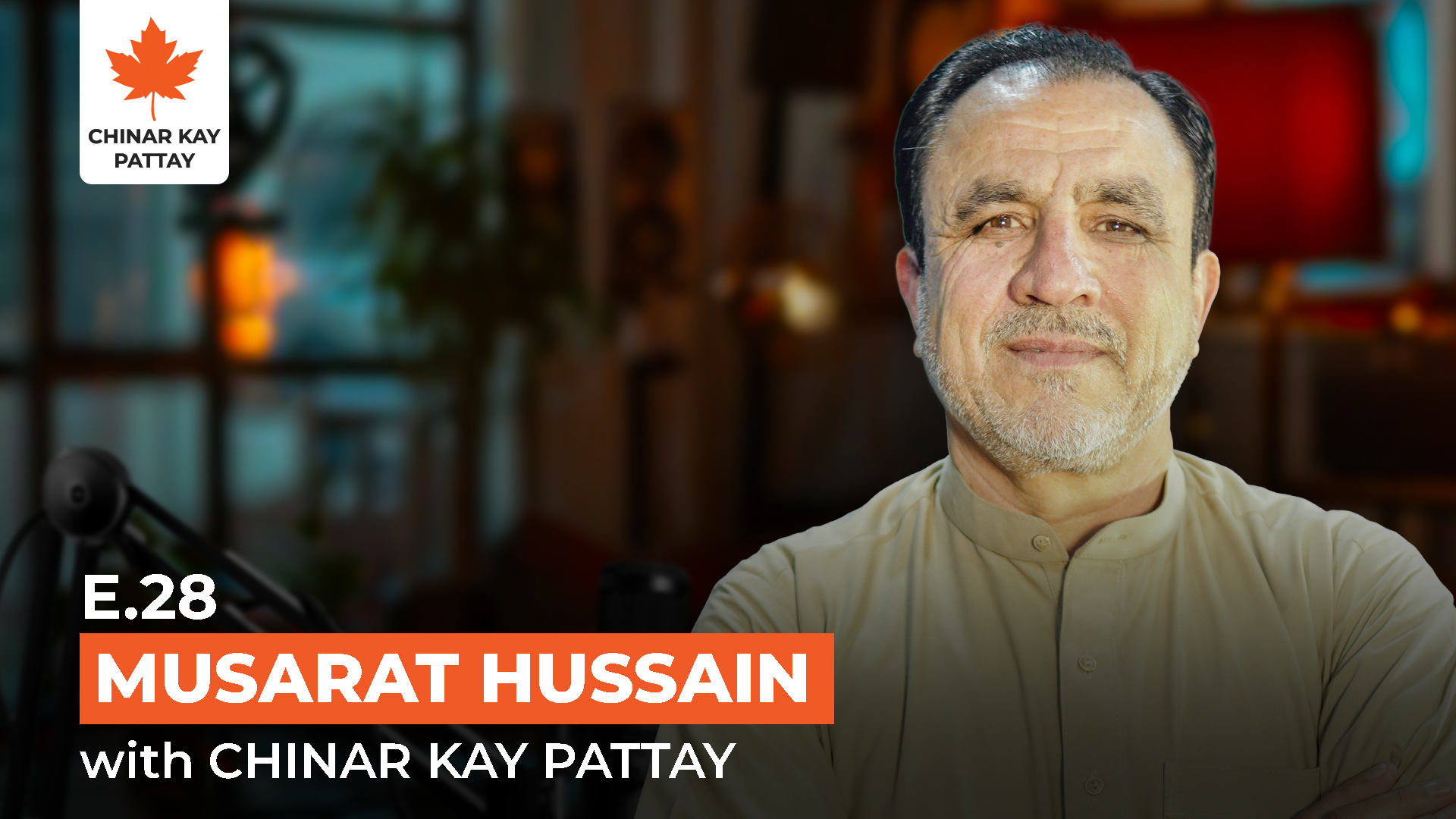
In Episode #028 of the Chinar Kay Pattay Podcast, host Shahid Hussain sits down with Musarat Hussain, founder of Tanzeem Tahafuz-e-Millat, for a wide-ranging conversation about social challenges and community development in District Kurram.
The discussion explores the organisation’s anti-drug efforts, cooperation with police, educational concerns, healthcare initiatives, opportunities for young people, agricultural problems, market pricing issues, and free medical camps.
Rather than focusing on one single problem, the episode raises a broader question:
What kind of local systems, community participation, and institutional cooperation are needed to create a stronger future for Kurram?
Watch the Full Podcast
Chinar Kay Pattay Podcast #028
Guest: Musarat Hussain
Host: Shahid Hussain
Guest Role: Founder, Tanzeem Tahafuz-e-Millat
Topic: Social Development, Anti-Drug Efforts, Youth Development and Community Challenges in Kurram
The complete conversation is available on the official Chinar Kay Pattay YouTube channel.
Table of Contents
Episode Timestamps
00:00 — Trailer
02:40 — Introduction & Past and Present Situation of District Kurram
05:33 — Role of Tanzeem Tahafuz-e-Millat in Combating Drug Supply
08:15 — Police Cooperation & Other Challenges
12:25 — Suggestions & Struggles in Kurram’s Education Sector
16:45 — Need for a Proper System in District Kurram
21:02 — Tanzeem’s Role & Efforts in Health Sector Improvement
25:10 — Tanzeem Tahafuz-e-Millat’s Role in Social Awareness
27:54 — Opportunities for Youth in Kurram
29:25 — Educated Youth within the Tanzeem
33:05 — Flaws in Agriculture Department & Farmers’ Struggles
37:44 — Overpricing Issues in Parachinar
39:54 — Free Medical Camps by the Tanzeem
42:43 — Chinar Kay Pattay — Closing Segment
Understanding Social Development in Kurram
When people talk about development, the discussion often moves quickly toward roads, buildings, jobs, or government projects.
But development is much broader than physical infrastructure.
A community also becomes stronger when people have access to:
- quality education;
- healthcare;
- opportunities for young people;
- safer social environments;
- productive livelihoods;
- effective institutions;
- reliable information;
- and ways to participate in solving local problems.
The conversation with Musarat Hussain looks at Kurram through this broader perspective.
The episode connects issues that may initially appear separate.
Drug distribution affects young people.
Educational weaknesses affect future opportunities.
Healthcare challenges affect families.
Agricultural problems affect livelihoods.
Overpricing affects household finances.
And weak coordination can make all of these problems harder to address.
The broader lesson is simple:
social problems are often connected, so long-term solutions also need to be connected.
Tanzeem Tahafuz-e-Millat and Anti-Drug Efforts
One of the central themes of the episode is the work of Tanzeem Tahafuz-e-Millat against drug supply and addiction-related problems.
Drug use among young people is not only a health concern.
It can affect:
- education;
- employment;
- families;
- personal safety;
- crime;
- physical and psychological health;
- and long-term social stability.
The organisation’s anti-drug efforts, as discussed by Musarat Hussain, reflect an important principle:
prevention cannot begin only after a young person has already developed an addiction.
Communities also need to think about:
- awareness;
- availability of drugs;
- social environments;
- enforcement;
- family involvement;
- education;
- treatment;
- and rehabilitation.
Community organisations can help create awareness and identify problems, but drug control cannot realistically depend on volunteers or social activists alone.
Law enforcement, health services, families, schools, rehabilitation services, and community leadership all have different roles.
That makes drug control a system issue rather than the responsibility of one organisation.
Police Cooperation and the Challenges of Drug Control
The podcast also discusses cooperation between Tanzeem Tahafuz-e-Millat and the police, along with challenges encountered in efforts to control drug supply.
This is an important part of the conversation because community activism and law enforcement operate differently.
Community organisations can:
- raise awareness;
- identify local concerns;
- encourage families to speak up;
- mobilise citizens;
- and advocate for action.
Police and other authorised institutions, however, are responsible for formal law-enforcement processes.
Effective cooperation therefore requires clear roles.
Community concerns can help institutions understand what people are experiencing, but allegations should still be handled through lawful investigation and due process.
This distinction is important.
Fighting drugs should not mean creating a culture of accusation without evidence.
A stronger system needs both:
community vigilance and lawful enforcement.
Education and the Need for Stronger Systems
The conversation moves beyond drug control into Kurram’s education sector.
Education affects almost every other area of development.
A strong education system can help young people develop:
- knowledge;
- practical skills;
- critical thinking;
- professional opportunities;
- confidence;
- and greater economic choices.
But the existence of schools and colleges alone does not guarantee educational quality.
The discussion raises broader concerns about how education functions and what improvements may be needed in District Kurram.
A serious conversation about educational development should ask questions such as:
- Are students actually learning?
- Are teachers properly supported?
- Are young people developing practical skills?
- Are institutions preparing students for changing labour markets?
- Is career guidance available?
- Are students being encouraged to think rather than only memorise?
- Are educational opportunities connected to real economic opportunities?
These are system-level questions.
Education becomes most valuable when it helps people participate more effectively in society and build meaningful futures.
Why Kurram Needs Better Coordination
A major theme of the episode is the need for a proper system in District Kurram.
This idea matters because many local problems are not necessarily caused by a complete absence of people willing to help.
Sometimes the deeper problem is that efforts are fragmented.
One organisation works on awareness.
Another institution handles healthcare.
Schools operate separately.
Farmers face their own problems.
Government departments have their own responsibilities.
Young people search individually for opportunities.
But without coordination, useful work can remain disconnected.
A stronger development approach asks:
Who is responsible for what?
Where are the gaps?
Which organisations already exist?
What can government do?
What can communities do?
What requires professional expertise?
And how can different efforts reinforce each other?
The answer is not necessarily one central organisation controlling everything.
The goal is a system in which different actors understand their roles and cooperate where cooperation adds value.
Community Efforts in the Health Sector
Healthcare is another major part of the discussion.
Tanzeem Tahafuz-e-Millat’s involvement in health-related activities, including medical camps discussed later in the episode, reflects the role that community organisations can sometimes play in helping people access services.
But temporary healthcare initiatives should also be understood within a wider system.
Medical camps can provide useful short-term support.
They may help with:
- consultations;
- basic screening;
- awareness;
- referrals;
- and reaching people who otherwise face difficulty accessing services.
However, a medical camp cannot replace permanent healthcare infrastructure.
Long-term health systems require:
- qualified professionals;
- functioning clinics and hospitals;
- medicines and equipment;
- referral pathways;
- diagnostics;
- continuity of care;
- preventive healthcare;
- and reliable public services.
Community initiatives can complement those systems.
They should not be expected to replace them.
Social Awareness and Community Responsibility
Tanzeem Tahafuz-e-Millat’s role in social awareness forms another part of the conversation.
Awareness is often underestimated because its results are harder to measure than a building or physical project.
But public knowledge influences behaviour.
People need awareness about:
- drugs;
- health;
- education;
- legal responsibilities;
- public services;
- agriculture;
- social problems;
- and opportunities.
The quality of awareness also matters.
Effective awareness should provide people with useful information rather than simply slogans.
For example, telling young people that drugs are harmful is important.
But stronger awareness would also help them understand:
- why addiction develops;
- where help is available;
- how families can respond;
- how peer pressure works;
- and what alternatives young people have.
The same principle applies across other sectors.
Good awareness helps people make better decisions.
Creating Opportunities for Kurram’s Youth
Kurram has many educated and ambitious young people.
But education without opportunity can create frustration.
The episode discusses opportunities for youth and the need to involve young people more meaningfully in the region’s future.
Youth development should not be understood only as creating government jobs.
Opportunities can come through different pathways:
- education;
- technical skills;
- entrepreneurship;
- digital work;
- agriculture;
- professional careers;
- local businesses;
- community organisations;
- research;
- technology;
- and connections with wider markets.
The challenge is helping young people identify realistic pathways.
This requires more than motivational speeches.
Young people need:
- information;
- training;
- mentorship;
- networks;
- practical skills;
- access to opportunities;
- and environments where useful ideas can be tested.
A strong youth-development system helps young people move from:
education → capability → opportunity → contribution.
The Role of Educated Young People
The episode specifically discusses educated young people working within Tanzeem Tahafuz-e-Millat.
This raises an important question:
What role should educated youth play in community development?
Education creates more value when knowledge is applied.
Young people with backgrounds in health, agriculture, technology, law, business, education, media, or other professions can contribute to community initiatives in different ways.
That does not mean every educated person must become a social activist.
But stronger communities benefit when professional knowledge becomes connected to public problems.
A graduate may contribute through research.
A doctor may support health awareness.
A teacher may support education.
A technology professional may create digital systems.
An entrepreneur may create jobs.
A journalist may improve public information.
The important point is that youth participation should make use of actual skills, not simply attendance at events.
Agriculture and the Challenges Facing Farmers
Agriculture forms another important part of the discussion.
Farmers may face difficulties related to:
- inputs;
- agricultural advice;
- markets;
- productivity;
- prices;
- access to technology;
- soil;
- water;
- storage;
- and institutional support.
Musarat Hussain discusses concerns relating to the Agriculture Department and farmers’ struggles.
These concerns are significant because agriculture remains connected to both livelihoods and food systems.
However, agricultural problems should not automatically be attributed to one department or one cause without proper evidence.
The more useful question is:
Where exactly does the agricultural system fail farmers?
Is the problem:
- information?
- quality inputs?
- research?
- extension services?
- markets?
- infrastructure?
- storage?
- transport?
- finance?
- or coordination?
Understanding the specific failure matters because different problems require different solutions.
Overpricing and Its Impact on Ordinary People
The episode also discusses overpricing in Parachinar.
Price increases directly affect households, especially when essential goods are involved.
But the term “overpricing” can describe different situations.
Prices can increase because of:
- supply shortages;
- transport costs;
- disruptions;
- market concentration;
- higher wholesale prices;
- seasonal changes;
- increased demand;
- or unlawful pricing practices.
Understanding the cause matters.
If the problem is an illegal pricing practice, enforcement may be relevant.
If the problem is supply disruption, the solution may involve logistics and diversified supply.
If competition is weak, market structure may matter.
If transportation is expensive, local sellers may themselves be facing higher costs.
This is why economic problems should be investigated rather than explained through assumptions alone.
For ordinary households, however, the impact remains straightforward:
higher prices reduce purchasing power and make everyday life more difficult.
Free Medical Camps and Community Support
The episode highlights free medical camps organised by Tanzeem Tahafuz-e-Millat.
Such initiatives can provide direct benefits to people who may otherwise struggle to access healthcare.
They can also connect social organisations with medical professionals and bring services closer to communities.
But their greatest long-term value may come when they are part of a broader health strategy.
For example, a medical camp can potentially help identify:
- common health concerns;
- patients needing referral;
- gaps in awareness;
- underserved communities;
- and areas where permanent services may be needed.
Temporary interventions are valuable.
But sustainable development also asks:
What happens after the camp ends?
That question applies far beyond healthcare.
Strong community development tries to convert temporary support into stronger systems wherever possible.
What This Conversation Means for Kurram
Episode #028 covers drugs, education, healthcare, youth, agriculture, prices, and community activism.
At first glance, that may seem like many separate conversations.
But they are connected.
A young person struggling with addiction may also lack opportunity.
Limited opportunity may be connected to education or the economy.
Weak agricultural systems affect rural livelihoods.
Healthcare gaps affect families.
High prices affect household stability.
Poor coordination makes existing institutions less effective.
This is why social development in Kurram needs systems thinking.
The goal is not to expect one Tanzeem, one activist, one government department, or one project to solve every problem.
Instead, the region needs different parts of society to perform their roles more effectively and connect where necessary.
Community organisations can raise issues.
Professionals can contribute expertise.
Government institutions have formal responsibilities.
Young people can build skills and participate.
Businesses can create economic activity.
Researchers can help identify what actually works.
And citizens can support constructive initiatives while also demanding accountability.
Development becomes stronger when these pieces reinforce each other.
Key Takeaways from the Episode
- Drug addiction is not only an individual problem; it affects families, young people, health, education and wider community wellbeing.
- Community organisations can support awareness and advocacy, but formal drug control also requires effective law enforcement and professional health services.
- Police-community cooperation should operate through lawful processes and clear responsibilities.
- Improving education requires more than increasing enrolment; quality, skills and future opportunities matter.
- Many of Kurram’s challenges require stronger coordination between institutions, professionals and communities.
- Community health initiatives such as medical camps can provide useful support but cannot replace permanent healthcare systems.
- Social awareness is most useful when it gives people practical knowledge rather than slogans alone.
- Youth development should connect education with skills, opportunities and meaningful participation.
- Educated young people can contribute more effectively when their professional skills are connected to real community needs.
- Agricultural problems should be diagnosed across the whole farming system rather than blamed automatically on one cause.
- High prices can have different causes and require evidence-based analysis before solutions are proposed.
- Community activism can identify problems and mobilise people, but sustainable progress depends on stronger systems and institutions.
Building Stronger Community Systems
One of the most valuable ideas emerging from Musarat Hussain’s conversation is that social development is not one project.
It is the result of many systems working together.
A community cannot become stronger through anti-drug campaigns alone.
It also needs meaningful opportunities for young people.
Education needs to lead toward useful knowledge and capability.
Farmers need better systems around production and markets.
Families need accessible healthcare.
Citizens need reliable information.
Institutions need accountability.
And community organisations need to complement—not replace—the responsibilities of professional and government systems.
The work of Tanzeem Tahafuz-e-Millat discussed in this episode illustrates how local citizens can organise around public problems and try to contribute.
But it also highlights a larger reality:
Kurram’s long-term development will require cooperation between communities, government institutions, professionals, young people, businesses, and civil society.
No single actor can do everything.
The stronger approach is to understand where each actor can contribute—and how those contributions can become part of a more effective local system.
For anyone interested in drug awareness, youth development, education, healthcare, agriculture, or the wider future of District Kurram, the full conversation offers several important points worth considering.
Watch the Full Episode
Watch Social, Anti-Drug Efforts & Youth Development in Kurram | Musarat Hussain | Chinar Kay Pattay Podcast #028 on the official Chinar Kay Pattay YouTube channel.
Subscribe to Chinar Kay Pattay for more conversations about Kurram, its people, social issues, development, education, healthcare, agriculture, youth opportunities, culture, and future.
Official Website
Facebook
Instagram
TikTok
If you know someone working in education, healthcare, youth development, agriculture, social work, or community service in Kurram, consider sharing this conversation with them.