
Kurram is a region shaped by a long history, strong tribal structures, diverse communities, and deep social connections. But when tensions return again and again, understanding the present requires more than looking at the most recent incident.
Why do conflicts in Kurram keep resurfacing?
Are they primarily tribal, sectarian, political, historical—or a combination of several factors?
How effective are traditional mechanisms such as the Jirga system in resolving disputes?
And perhaps most importantly: what can communities, institutions, and young people do to prevent the same cycle from repeating?
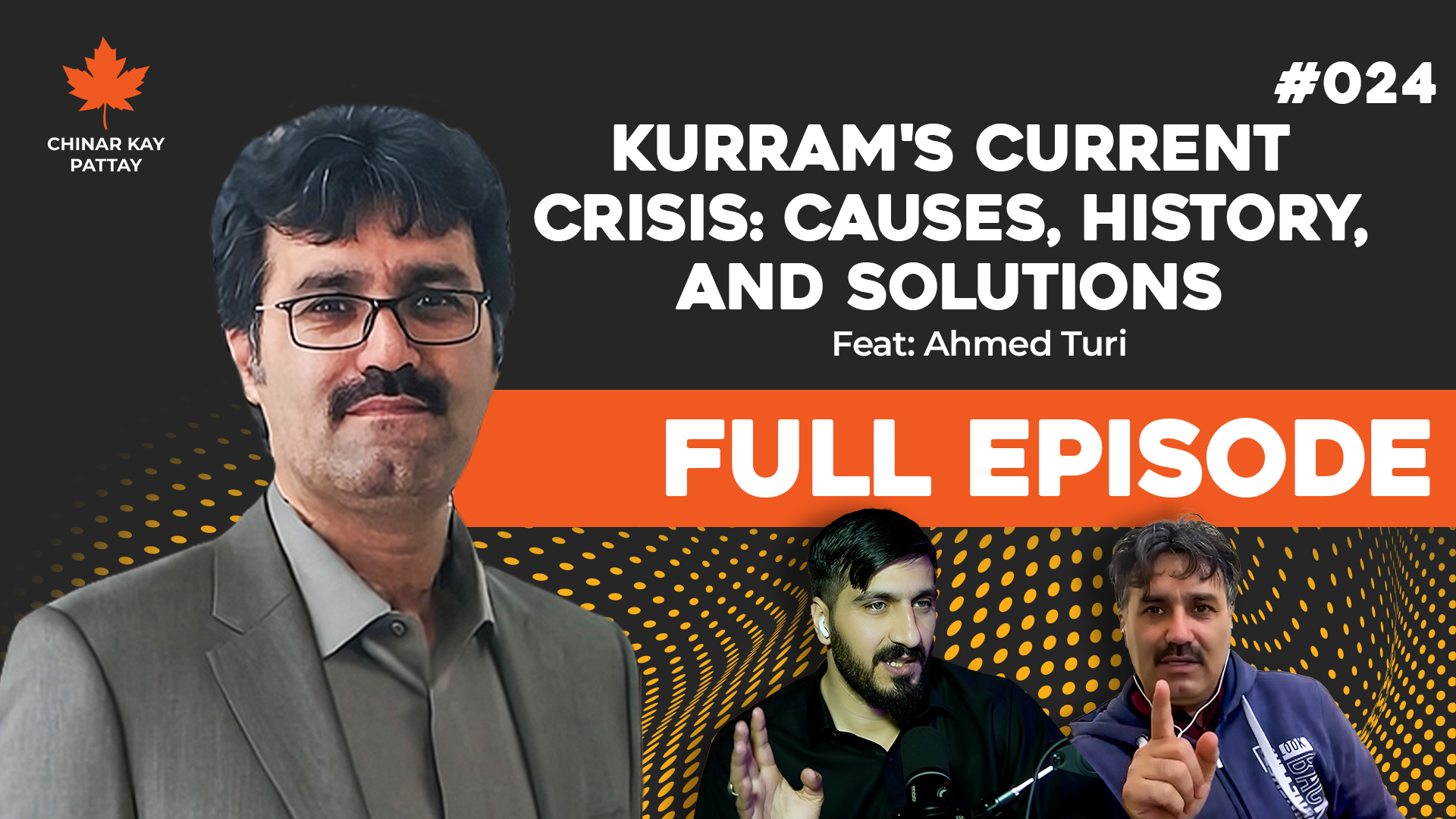
In Episode #024 of the Chinar Kay Pattay Podcast, host Dilawar Hussain sits down with Ahmed Turi, a historian, analyst, and owner of The Parachinar Observer, for an extended conversation about the current situation in Kurram District.
Rather than discussing only individual incidents, the conversation explores the historical roots of conflict, recurring tribal tensions, recent events, the Jirga system, public trust, community responsibility, and the difficult question of how lasting peace can be built in Kurram.
For anyone trying to understand Kurram beyond headlines and short social-media updates, this episode offers a broader local perspective on why the region’s conflicts cannot be understood in isolation.
Watch the Full Podcast
Chinar Kay Pattay Podcast #024
Guest: Ahmed Turi
Host: Dilawar Hussain
Topic: Current Situation in Kurram — Historical Roots, Causes & Solutions
The complete discussion is available on the Chinar Kay Pattay YouTube channel.
Table of Contents
Episode Timestamps
00:00:00 — Introduction
00:00:42 — Why is Kurram Facing Conflict? Exploring the Root Causes
00:04:36 — Recent Events Escalating Tensions in Kurram District
00:09:09 — The Evolution of the Jirga System, Grand Jirga and Recent Conflict Resolution
00:16:49 — Historical Roots of Tribal Conflicts in Kurram District
00:24:24 — Why Do Tensions Keep Resurfacing in Kurram?
00:29:07 — Main Causes of Conflicts in Kurram: Sectarian, Tribal or Political?
00:36:26 — Preventing Recurring Issues: Convoy Attacks and Community Measures
00:48:33 — Why Are Tribal People Losing Trust in Government Over Convoy Attacks?
00:52:41 — Arrest of Tehsil Chairman Muzamil Hussain Faseeh and Questions Around the FIR
00:57:16 — Message to the People of Kurram: Youth, Peace and Progress
01:01:44 — Chinar Kay Pattay
Understanding Conflict Beyond the Latest Incident
When violence or tension breaks out in Kurram, public discussion naturally focuses on the immediate event.
What happened?
Who was involved?
What will happen next?
Those questions matter. But they do not necessarily explain why similar tensions return.
One of the central themes of this conversation with Ahmed Turi is the importance of looking beneath individual incidents and understanding the structures, relationships, unresolved disputes, and historical dynamics surrounding them.
The episode begins by examining the root causes behind conflict in Kurram and then moves into the recent developments that intensified tensions.
This distinction is important.
An event may trigger a crisis, but the trigger and the underlying cause are not always the same thing.
For Kurram, understanding conflict therefore requires looking at both the immediate circumstances and the longer history behind relations among different tribes and communities.
That is also why conversations about peace cannot focus only on bringing one confrontation to an end.
If the underlying issues remain unresolved, tension can return.
The Historical Roots of Tribal Conflict in Kurram
Kurram’s present cannot be separated completely from its past.
The district has a complex tribal and social history, and disputes that exist today may carry memories, grievances, relationships, or disagreements extending well beyond the latest crisis.
In the podcast, Ahmed Turi discusses the historical roots of tribal conflict in Kurram and why understanding that history matters when trying to make sense of present-day tensions.
This is one of the most important lessons from the episode:
Conflict should not be analysed only from the moment violence begins.
Historical context can help explain why certain disputes become sensitive, why mistrust can survive for long periods, and why apparently resolved issues may sometimes resurface.
At the same time, history should not become an excuse for accepting permanent conflict.
Understanding the past should help communities identify what continues to create tension in the present—and what needs to change to prevent another generation from inheriting the same problems.
For young people especially, this distinction matters.
Knowing history is valuable.
Remaining trapped inside historical hostility is something entirely different.
Tribal, Sectarian or Political? Why Simple Labels Can Be Misleading
One of the major questions addressed in the episode is whether conflicts in Kurram should be understood as:
- tribal;
- sectarian;
- political;
- or some combination of these factors.
This is an important question because the label attached to a conflict can shape how people understand it.
If every dispute is described purely through a sectarian lens, underlying tribal, territorial, political, administrative, or historical dimensions may receive less attention.
On the other hand, ignoring sectarian sensitivities where they genuinely matter can also produce an incomplete picture.
The conversation with Ahmed Turi therefore raises a broader point about analysing Kurram:
complex conflicts rarely fit comfortably into one label.
Understanding them requires looking at how different factors interact.
Who are the parties to a dispute?
What is the history between them?
What grievances are being raised?
How have previous disputes been handled?
What role do political and administrative institutions play?
How does public messaging influence tensions?
And which issues belong specifically to one incident rather than being treated as explanations for every conflict in Kurram?
These questions matter because inaccurate or oversimplified narratives can themselves deepen mistrust.
For a region trying to build long-term peace, careful language is not a minor concern. It is part of responsible public communication.
Why Do Tensions Keep Resurfacing?
Reaching a temporary settlement is not necessarily the same as resolving a conflict.
A ceasefire may stop immediate violence.
A Jirga may bring representatives together.
An agreement may create space for normal life to return.
But if the underlying causes of mistrust remain, another incident can reopen old divisions.
This issue forms an important part of Ahmed Turi’s discussion.
Why do tensions return?
Why can an issue that appears settled become a source of conflict again?
These questions move the conversation from short-term crisis management toward long-term conflict prevention.
Sustainable peace requires more than reacting after violence begins.
It requires systems capable of identifying disputes earlier, maintaining communication between communities, resolving grievances fairly, implementing agreements, and maintaining public confidence in the institutions responsible for security and justice.
The episode therefore encourages viewers to think not only about how conflict ends, but about how recurrence can be prevented.
That is a much harder question—but ultimately a more important one.
The Jirga System and Its Role in Conflict Resolution
Traditional dispute-resolution mechanisms have long played an important role in tribal societies across the region, and the Jirga system is a central part of the conversation in Episode #024.
Ahmed Turi discusses the evolution of the Jirga system, the role of the Grand Jirga, and the use of Jirgas in efforts to address recent conflict.
At its core, a Jirga creates a space where representatives can communicate, negotiate, and search for a settlement.
In situations where direct communication between conflicting sides becomes difficult, such mechanisms can provide a channel for dialogue.
But the deeper question is not simply whether a Jirga takes place.
The real measure of any peace mechanism is whether agreements can be implemented and whether the underlying dispute is addressed strongly enough to prevent recurrence.
That means conflict resolution involves more than reaching an agreement at the negotiating table.
It also raises questions of:
- implementation;
- accountability;
- representation;
- communication;
- trust;
- follow-through;
- and institutional support.
The discussion therefore places the Jirga within the wider challenge of building durable peace rather than treating it as a ceremonial solution to every conflict.
Convoy Attacks, Security and the Question of Public Trust
The podcast also enters one of the most sensitive parts of the contemporary discussion in Kurram: convoy attacks and the public response to security incidents.
Ahmed Turi discusses measures that communities and institutions could consider to prevent recurring incidents and explores why such attacks can damage public confidence.
Security is not only about preventing an attack.
It is also about whether people believe that systems designed to protect them are functioning fairly and effectively.
When serious incidents recur, questions inevitably emerge:
Were risks understood?
Could anything have been done differently?
Are investigations trusted?
Do communities believe that accountability will follow?
What measures can prevent another incident?
These are difficult questions, especially in an environment where rumours, anger, grief, political disagreement, and incomplete information can spread quickly.
That makes transparent communication especially important.
When public trust weakens, even legitimate actions can be interpreted through suspicion.
Rebuilding confidence therefore requires more than statements. It depends on credible institutions, consistent action, communication, and a sense among communities that their security concerns are being taken seriously.
The episode does not reduce this challenge to a single answer. Instead, it places public trust at the centre of the conversation about lasting stability.
The Arrest of Tehsil Chairman Muzamil Hussain Faseeh and Questions Around the FIR
At approximately 52:41, the conversation turns to the arrest of Tehsil Chairman Muzamil Hussain Faseeh and questions surrounding the FIR connected with the case.
Because this is a legal and politically sensitive subject, it is important to distinguish between questions and claims discussed in the podcast and independently established legal findings.
The episode raises questions about the circumstances of the case and whether the FIR was forged.
These questions should not be presented as settled conclusions without verified documentary or legal evidence.
What this part of the conversation does illustrate, however, is the wider relationship between law enforcement and public confidence.
When communities question the legitimacy of an investigation, arrest, FIR, or other legal process, the issue can quickly move beyond the individual case and become a larger question about institutional trust.
For that reason, transparency, due process, reliable documentation, and factual public communication become especially important in sensitive environments.
Peace Requires More Than Ending a Single Conflict
Throughout the conversation, a broader idea emerges:
Kurram’s challenge is not simply to stop the current crisis.
The larger challenge is to prevent the next one.
Long-term peace requires the ability to deal with disagreement before it becomes violence.
That may involve stronger dialogue between communities, functioning conflict-resolution mechanisms, trusted public institutions, responsible leadership, enforcement of agreements, and better ways of addressing rumours and misinformation.
It also requires recognising that peace cannot rest entirely on one institution.
Government has responsibilities.
Local leadership has responsibilities.
Tribal representatives have responsibilities.
Religious and community figures can influence public attitudes.
Media and social-media users have responsibilities.
And ordinary citizens also shape the environment in which conflict either spreads or loses support.
The exact balance between these responsibilities may be debated, but the larger principle remains important:
peace is not created only when fighting stops. It is strengthened through the systems that make renewed fighting less likely.
The Role of Kurram’s Youth
The final major part of the podcast turns toward young people.
Ahmed Turi shares a message for the people of Kurram and discusses how the youth can contribute to peace and progress.
This may be one of the most important dimensions of the conversation.
Young people inherit both the strengths and unresolved problems of their communities.
They also now operate in an information environment very different from previous generations.
A rumour can travel across Kurram within minutes.
An inflammatory post can reach thousands of people.
Old footage can be presented as a new incident.
Unverified claims can quickly shape public emotion.
But the same communication tools can also be used differently.
Young people can:
- question misinformation before sharing it;
- learn the history of their region seriously;
- engage with people outside their immediate social circles;
- challenge narratives that treat conflict as inevitable;
- use education, entrepreneurship and professional skills to strengthen society;
- document Kurram’s history and culture responsibly;
- promote dialogue rather than humiliation and provocation;
- and create public conversations centred on progress rather than permanent division.
Youth participation in peace does not mean pretending disagreements do not exist.
It means refusing to allow every disagreement to become another inherited conflict.
A generation capable of asking difficult questions without immediately turning those questions into hostility can become one of Kurram’s strongest long-term assets.
What This Conversation Tells Us About Kurram
Episode #024 is ultimately about more than identifying a single cause of conflict.
It is about understanding layers.
History matters.
Tribal dynamics matter.
Sectarian sensitivities can matter.
Politics and institutions matter.
Security matters.
Trust matters.
Traditional conflict-resolution mechanisms matter.
And the behaviour of communities themselves matters.
Reducing such a complex environment to one explanation may make a story easier to tell, but it does not necessarily make it more accurate.
The more useful question is:
What combination of unresolved issues allows conflict to return—and what combination of institutions, community action and social change can make peace more durable?
That is a question Kurram cannot answer through one podcast episode alone.
But conversations like this can help create a more informed starting point.
Key Takeaways from the Episode
- Understanding Kurram’s current tensions requires looking beyond individual incidents and considering historical context.
- Tribal, sectarian and political explanations should not automatically be treated as mutually exclusive.
- Temporary settlements do not necessarily resolve the underlying causes of recurring tension.
- Jirgas and Grand Jirgas remain important parts of the conflict-resolution conversation, but implementation and trust also matter.
- Security incidents can have consequences far beyond the immediate event by weakening public confidence.
- Sensitive legal and political claims should be handled with evidence rather than rumours or assumptions.
- Long-term peace requires participation from institutions, tribal and community leadership, civil society and citizens.
- Young people have an important role in challenging misinformation, reducing hostility and building a stronger future for Kurram.
A Future Beyond Recurring Conflict
Kurram has lived through enough cycles in which a new incident brings old fears, grievances, and divisions back to the surface.
Breaking that cycle requires more than hoping the next crisis does not happen.
It requires understanding why conflict returns.
It requires examining history without becoming imprisoned by it.
It requires strengthening mechanisms for dialogue and conflict resolution.
It requires credible public institutions.
And it requires a generation willing to imagine Kurram not only through the conflicts it has experienced, but through the future it could build.
The conversation with Ahmed Turi does not claim to provide one simple solution to every problem facing the district.
Instead, it asks something more fundamental:
Can Kurram understand its conflicts deeply enough to stop repeating them?
For people interested in the history, politics, tribal dynamics and future of Kurram, the full conversation is worth watching.
Watch the Full Episode
Watch Current Situation in Kurram: Historical Roots, Causes & Solutions | Ahmed Turi | Chinar Kay Pattay Podcast #024 on the official Chinar Kay Pattay YouTube channel.
Subscribe to Chinar Kay Pattay for more conversations about Kurram, its people, history, challenges, opportunities and future.
YouTube
Official Website
Facebook
Instagram
TikTok
If this conversation adds something useful to your understanding of Kurram, share it with someone who should be part of the discussion.